Early Childhood Development Course
21st Century Teaching
The foundations of learning are laid before formal schooling begins. This course equips ECD practitioners to see every child clearly from the very start, before the gaps have a chance to grow.
A child who is seen clearly at three years old does not have to wait until Grade 9 for someone to finally understand what they need.

Every child who arrives in Grade 1 with an unidentified developmental difference has been visible to someone before that moment. An ECD practitioner who knows what to look for can change the entire trajectory of that child's education.
This course equips practitioners with the frameworks to identify developmental differences early, design environments that support how young children actually learn and communicate what they observe to the primary phase so nothing is lost in transition.
When ECD practitioners and primary teachers use the same identification language, a child's profile travels with them across phases rather than being discovered from scratch at each new stage. The earlier a gap is seen, the smaller it stays.
This training does not just explain child-led learning. It puts practitioners inside it. The activities are designed to reconnect educators with the way discovery actually feels before it gets structured out of a child.




Practitioners work through a task using only their hands and the materials in front of them, no instructions, no demonstration. The insight is immediate: this is how a child under five processes everything, and it is extraordinary what can be built when the adult gets out of the way.
Practitioners observe a play scenario and practise the discipline of not stepping in. What they notice when they slow down and watch - about development, about communication, about what a child is actually doing changes how they move through an ECD environment from that point on.
Practitioners redesign a learning space with a three-year-old's experience in mind. What invites curiosity? What signals safety? What unintentionally tells a child this space is not for them? Small decisions that were made by default are examined and remade with intention.
Using real scenarios, practitioners practise identifying developmental signals in play behaviour not to diagnose, but to notice, name and communicate. The frameworks are the same ones used in the primary and high school courses, adapted for the earliest phase of learning.
ECD practitioners are often the least resourced and least recognised educators in the system. The reflection circles in this training give them space to name that, and to understand why their role is not the beginning of schooling - it is the foundation everything else is built on.
When a practitioner understands how a child learns through play, they stop filling the silence and start reading what it is saying.
Equipping an ECD practitioner changes the trajectory of every child who passes through their hands. That is not one classroom. It is dozens of children, across years, who are seen earlier and supported better.
Fund a single ECD practitioner through the full two-day workshop. Their workbook, stationery and certificate are covered. They leave with new eyes for every child in their care.
Fund the full staff team of an ECD centre. When every practitioner at a centre shares the same frameworks, the environment shifts. Every child who walks in is seen the same way, by everyone.
Fund ECD and primary staff together so the identification language is shared across the transition. A child who is seen clearly at three does not have to be discovered again at seven.
Multi-centre, multi-year CSI investment. Structured reporting, co-branding and the ability to track measurable impact across the ECD centres and schools you support.
Every sponsored practitioner receives the same materials. Every sponsored centre receives the same classroom resources. No centre is resourced differently to another.
All sponsorship enquiries are handled directly by GCC. Pricing is available on request and can be structured to suit individual, centre or corporate giving frameworks.
A child who arrives in Grade 1 with an unidentified developmental difference does not have a learning problem. They have a visibility problem. No one has yet seen what they need.

Primary School
The next phase in the ecosystem. When ECD and primary educators share the same identification frameworks, nothing is lost in the transition from one to the other.
View the course
High School
The learner who is seen clearly at three does not arrive in high school as a mystery. The course that equips secondary educators to understand the adolescent brain and the learning differences that have followed a learner through the system.
View the course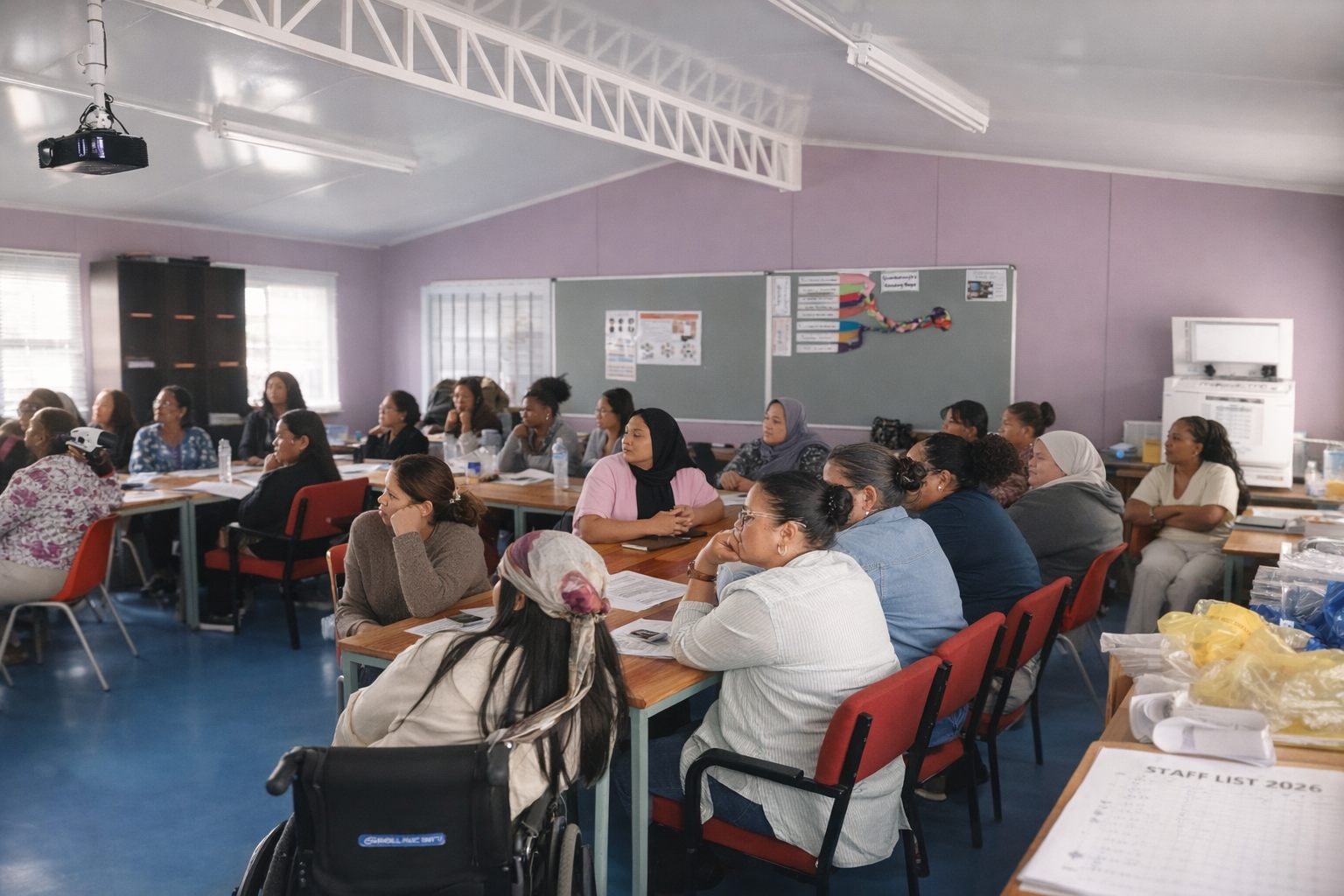
Behaviour Under Pressure
A one-day workshop for all phases. Understanding behaviour as a signal rather than a problem is as relevant in an ECD environment as it is in a high school classroom.
View the courseBring this training
to your ECD centre.
The two-day workshop is delivered on-site. Contact GCC to discuss booking for your ECD staff.

